

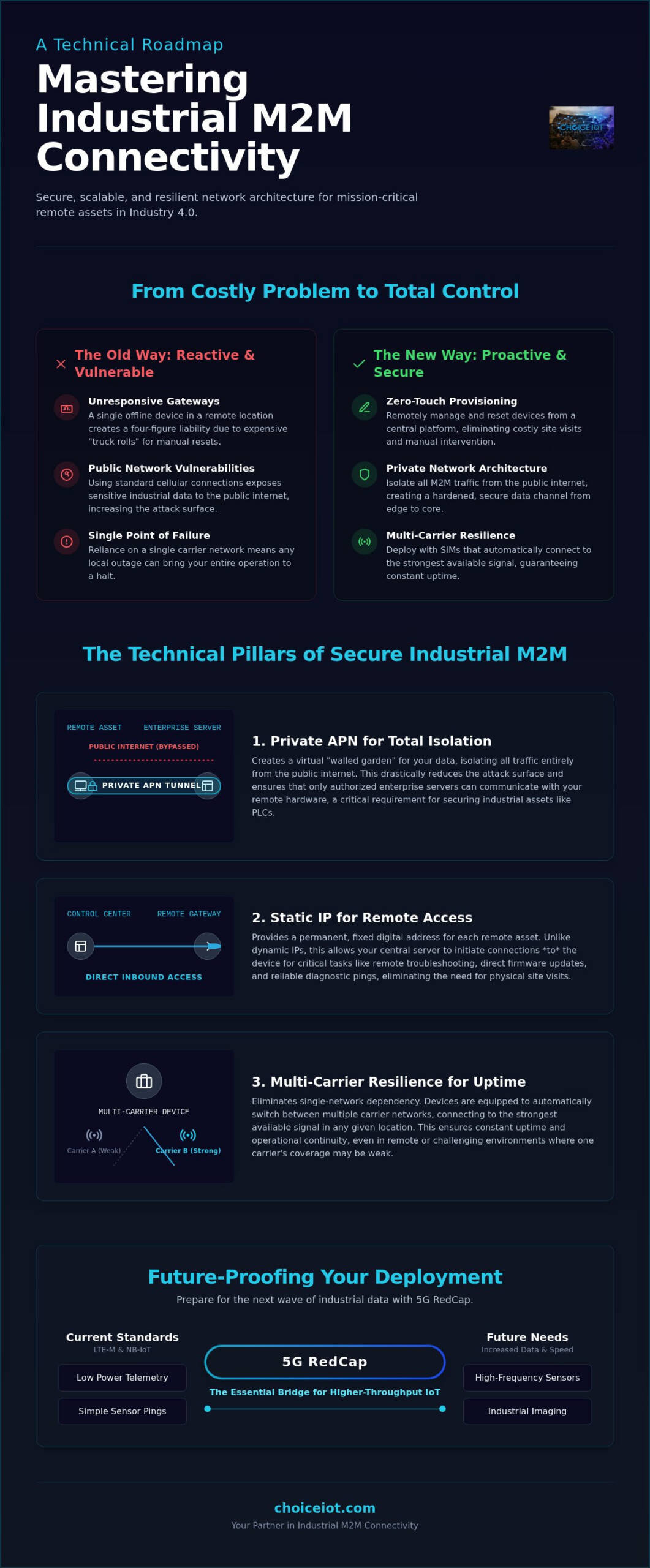
A single unresponsive gateway in a remote field isn’t just a technical glitch. It is a four-figure liability. For years, enterprises have accepted “truck rolls” and rogue data overages as the unavoidable cost of doing business. You shouldn’t have to. You’re likely tired of public network vulnerabilities and the logistical nightmare of manual resets. It is time to regain control.
This guide empowers you to master industrial m2m connectivity using architecture designed for 2026. Deploying secure, scalable networks requires more than just a signal; it demands a strategic foundation. We will show you how to implement zero-touch provisioning and achieve total visibility across every carrier in your fleet. We’ll break down the shift toward 5G RedCap, the necessity of Private APNs for security, and the management strategies that turn your remote hardware into a high-performance engine. From the EU’s Cyber Resilience Act requirements to the latest FCC “Covered List” updates, we provide the technical roadmap to ensure your data stays private and your costs stay predictable. Scale fast. Stay secure. Eliminate the friction.
Key Takeaways
- Understand why industrial m2m connectivity has evolved into the mission-critical backbone of Industry 4.0, moving beyond simple automation to total remote asset control.
- Secure your infrastructure by implementing Private APN architecture to keep sensitive industrial data entirely off the public internet.
- Master operational efficiency with centralized management platforms that provide real-time visibility and eliminate costly “truck rolls” via remote network resets.
- Future-proof your deployment by integrating 5G RedCap as the essential bridge for high-frequency sensors and industrial imaging.
- Build resilience through multi-carrier strategies that ensure constant uptime even in the most challenging remote environments.
What is Industrial M2M Connectivity and Why is it Evolving?
Industrial M2M connectivity is the backbone of Industry 4.0. It enables seamless, automated data exchange between remote assets without human intervention. While consumer applications focus on convenience, industrial systems focus on survival. Smart grids. Heavy construction. Global logistics fleets. These aren’t just gadgets; they’re high-stakes operational assets. Reliability isn’t a feature here; it’s the foundation.
The landscape is shifting rapidly. Simple telemetry pings are a thing of the past. Today, enterprises rely on Machine-to-machine (M2M) communication to transmit high-frequency, real-time data that dictates operational decisions. Downtime carries a heavy price tag. Mastering industrial m2m connectivity requires a move away from single-network dependencies toward multi-carrier redundancy. If one network drops, your operations shouldn’t.
M2M vs. IoT: Understanding the Industrial Nuance
The terms are often used interchangeably, but the distinction matters for enterprise reliability. M2M is traditionally point-to-point and hardware-centric. IoT represents a broader, cloud-integrated ecosystem. Industrial applications prioritize M2M because it offers closed-loop reliability and hardened security. M2M is the plumbing of the industrial internet. It provides the essential, dedicated channels required for mission-critical tasks where public cloud latency is unacceptable.
The Role of Cellular in Modern Industrial Environments
Cellular technology is the clear winner for terrestrial industrial deployments. Wi-Fi lacks the range and hand-off capabilities for mobile assets. Satellite often carries prohibitive costs and latency issues. Cellular offers the perfect balance of coverage and speed. To avoid a single point of failure, enterprises are increasingly adopting multi carrier iot sim cards. This ensures that your devices stay connected to the strongest available signal, regardless of location.
We’re also seeing a massive infrastructure transition. Carriers are sunsetting 2G and 3G networks. The industry is migrating toward LTE-M and NB-IoT. These standards provide better penetration in deep industrial settings and lower power consumption. They’re designed for the long haul. Modern connectivity isn’t just about getting online; it’s about staying online through every technical shift.
The Technical Pillars of Secure Industrial Communication
Secure communication is not an accident. It is engineered. In industrial m2m connectivity, data travels a precise path. Sensor to gateway. Gateway to carrier core. Core to enterprise server. Every hop must be hardened. Public internet exposure is a liability you can’t afford. You need a closed loop. Hardened infrastructure. Total isolation.
Reliability depends on the integrity of this transport layer. If your data hits the open web, it’s vulnerable. If your hardware isn’t certified, it’s unstable. Building a resilient network requires three specific technical pillars: Private APN, Static IP addresses, and certified hardware. Without these, you’re just hoping for uptime. With them, you’re guaranteeing it.
Securing the Industrial Edge with Private APN
Standard cellular connections are inherently “open.” This is a massive risk. A Private APN creates a virtual walled garden for your data. It isolates your traffic from the public web entirely. This architecture significantly reduces the attack surface for remote Programmable Logic Controllers (PLCs). It is a vital component when managing IoT connectivity for construction sites where assets are scattered and vulnerable. By solving Industrial IoT security challenges at the transport layer, you ensure only authorized users can touch your hardware.
Static IP Addresses for Remote Access and Control
Management requires a two-way street. Dynamic IPs are fine for consumer phones, but they fail in industrial environments. You need a Static IP Address. This allows your central server to “find” the remote device at any time. It facilitates inbound access for critical tasks. A static IP acts as a permanent digital address for your gateway, ensuring you never lose the ability to reach the edge.
- Remote troubleshooting without expensive site visits.
- Direct firmware updates to patch vulnerabilities in real time.
- Reliable diagnostic pings to verify operational status.
Hardware and network must be in sync. Carrier device certification guarantees compatibility. It prevents network rejection. It ensures your modems talk to towers correctly. No certification means no reliability. You can review secure connectivity options that integrate these technical pillars into a single, high-performance solution. Hardened security. Direct access. Certified performance.
Operational Control: Managing Deployment at Scale
Deployment is only the first step. Scale is where the real challenge begins. Managing a handful of sensors is straightforward. Managing a global fleet of ten thousand assets is a logistical war. You need a centralized brain to maintain order. A Connectivity Management Platform (CMP) serves as this operational core. It transforms a fragmented network into a single, cohesive system. Without centralized control, industrial m2m connectivity becomes a source of friction rather than a tool for growth.
Visibility prevents “bill shock.” Rogue devices or misconfigured gateways can consume massive amounts of data in hours. You can’t wait for the monthly statement to find out. Real-time monitoring allows you to set hard caps and receive instant notifications. Total visibility. Zero surprises. This level of oversight is essential for maintaining predictable operational margins in competitive industrial sectors. For enterprises managing mobile assets across regions, a robust strategy for IoT connectivity for fleet management is equally critical to eliminating data overages and ensuring constant uptime across every vehicle in your network.
Automating Security with the CAMP™ Platform
The CAMP™ IoT Platform automates the heavy lifting of network security. It uses Intelligent Alerts to identify anomalous data patterns the moment they occur. If a device exceeds its typical threshold, you know immediately. Instant detection. Rapid response. Minimal risk. The “SIM Lock & Security” feature adds another layer of protection. It binds your Multi-Carrier IoT SIM to a specific device IMEI. If a SIM is removed from a remote gateway, it stops working. Data theft becomes impossible. These standards align with best practices from the Consortium for IIoT & M2M Technologies, ensuring your deployment remains resilient against physical tampering.
Reducing OpEx through Remote Diagnostics
Physical site visits are the hidden killer of ROI. In the industry, we call this the “truck roll.” Sending a technician to a remote substation or a construction site just to power-cycle a modem is a massive waste of resources. It’s inefficient. It’s expensive. It’s unnecessary. You can resolve 90% of connectivity hurdles from your central dashboard using remote diagnostic tools.
Our IoT connectivity management platform empowers your team with Remote Network Resets. You can re-establish a connection without leaving your office. Diagnostic tools show you real-time signal strength and carrier latency. You see what the device sees. This proactive approach slashes operating expenses and keeps your uptime high. Centralize your fleet management today to eliminate logistical friction and secure your bottom line.
Future-Proofing with 5G Redcap and Multi-Carrier Resilience
The transition to 5G is no longer a future roadmap item. It is the current standard for enterprise reliability. 5G Redcap (Reduced Capability) serves as the critical bridge in industrial m2m connectivity. It fills the gap between low-power NB-IoT and the ultra-high speeds of full-tier 5G. This technology delivers the throughput required for industrial imaging and high-frequency sensors while maintaining the power efficiency of legacy systems. It is the lean, high-performance engine your fleet needs.
Legacy 4G LTE networks will eventually face the same sunset as 2G and 3G. Transitioning now prevents a forced migration later. 5G Redcap offers a native path to 5G Standalone (SA) cores, ensuring your hardware remains compatible with carrier infrastructure for the next decade. By adopting 3GPP Release 17 standards today, you secure years of operational continuity. No more hardware swaps. No more network anxiety. Optimize performance. Reduce complexity. Secure the future.
Why 5G Redcap is the New Industrial Standard
Industrial cameras and mid-tier telematics require more bandwidth than NB-IoT can provide, but they don’t need the multi-gigabit speeds of full 5G. Redcap provides a balanced solution. It offers data rates up to 150 Mbps. This is more than enough for real-time video surveillance or complex robotic control. For sites requiring even higher throughput for backhaul or primary office connectivity, fixed wireless connectivity for business serves as a powerful high-bandwidth complement.
- Optimized power consumption for battery-dependent remote sensors.
- Reduced hardware complexity for lower device costs.
- Native integration with 5G security protocols for hardened data protection.
Selecting the Right Partner for Global Industrial Scaling
Reliability isn’t just about the network. It’s about the partner behind it. You need more than a vendor; you need an expert in carrier certification and platform depth. Choice IoT provides the technical foundation for 5G Redcap deployment. We manage the complexities of carrier relationships and hardware certification so you can focus on scaling your operations. For VARs and integrators, our white-label management options provide a seamless way to deliver enterprise-grade industrial m2m connectivity to your own clients.
The window for strategic migration is open. Don’t wait for the next network sunset to audit your infrastructure. Contact Choice IoT today to audit your industrial connectivity strategy. Build for 2026. Secure your fleet. Master your data.
Secure Your Operational Future
Reliability is a strategic choice. You’ve seen how the technical pillars of Private APN and Static IP options secure your edge. You understand why 5G RedCap is the essential bridge for future-proofing your fleet. Now, it’s time to centralize that power. Managing industrial m2m connectivity shouldn’t be a source of logistical stress. It should be your most consistent competitive advantage. Total control. Streamlined simplicity. Maximum uptime.
The CAMP™ platform provides the real-time visibility you need across all major carriers. Stop guessing about data usage. Eliminate truck rolls with our Remote Network Reset feature. Resolve issues in seconds from your desk. You gain the ability to monitor, diagnose, and reset remote hardware without ever leaving the office. It’s about removing friction and protecting your bottom line.
Don’t let legacy infrastructure or public network vulnerabilities hold your enterprise back. Take the first step toward a more resilient, cost-effective network today. Request a Demo of the CAMP™ Platform and see how we simplify global deployment. Your operations are ready for the next level. Let’s build it.
Frequently Asked Questions
What is the difference between M2M and standard cellular data plans?
M2M plans are engineered specifically for automated device-to-device communication rather than human consumption. They prioritize consistent uptime and low-latency data transmission over high-speed media streaming. Unlike consumer plans, M2M offerings include specialized features like data pooling, static IP addresses, and ruggedized SIM cards designed for harsh environments.
How does a Private APN improve industrial M2M security?
A Private APN creates a secure, virtual tunnel that isolates your device traffic from the public internet entirely. This architecture prevents unauthorized external entities from discovering or accessing your remote hardware. It effectively extends your internal corporate network to the edge, ensuring that sensitive data remains within a controlled, private environment at all times.
Can I manage SIMs from multiple carriers in a single dashboard?
Yes, centralized platforms like CAMP™ allow you to monitor and manage all carriers through one interface. This eliminates the inefficiency of logging into separate portal environments for every network provider. You gain a single pane of glass for total fleet visibility. Real-time diagnostics. Unified billing. Simplified control.
What are the most common causes of “bill shock” in industrial M2M?
Bill shock usually occurs when rogue devices consume excessive data due to firmware errors or network misconfigurations. Without automated alerts, these overages accumulate rapidly and remain hidden until the end of the billing cycle. Managing industrial m2m connectivity through a platform with real-time usage caps and intelligent alerts prevents these unexpected costs before they scale.
How does 5G Redcap benefit industrial sensor networks?
5G Redcap provides a mid-tier performance level that balances high throughput with extreme power efficiency. It supports data rates up to 150 Mbps, which is ideal for industrial cameras and high-frequency sensors that outpace NB-IoT. This technology ensures your sensors remain connected to the latest 5G infrastructure without the battery drain or hardware cost of full-tier 5G modems.
What is a “Remote Network Reset” and why is it important for M2M?
A Remote Network Reset allows you to re-establish a device’s connection from your central dashboard without sending a technician to the site. This feature is vital for maintaining industrial m2m connectivity in remote or inaccessible locations. It eliminates the high cost of “truck rolls” by resolving common handshake issues and connectivity hangs instantly and remotely.